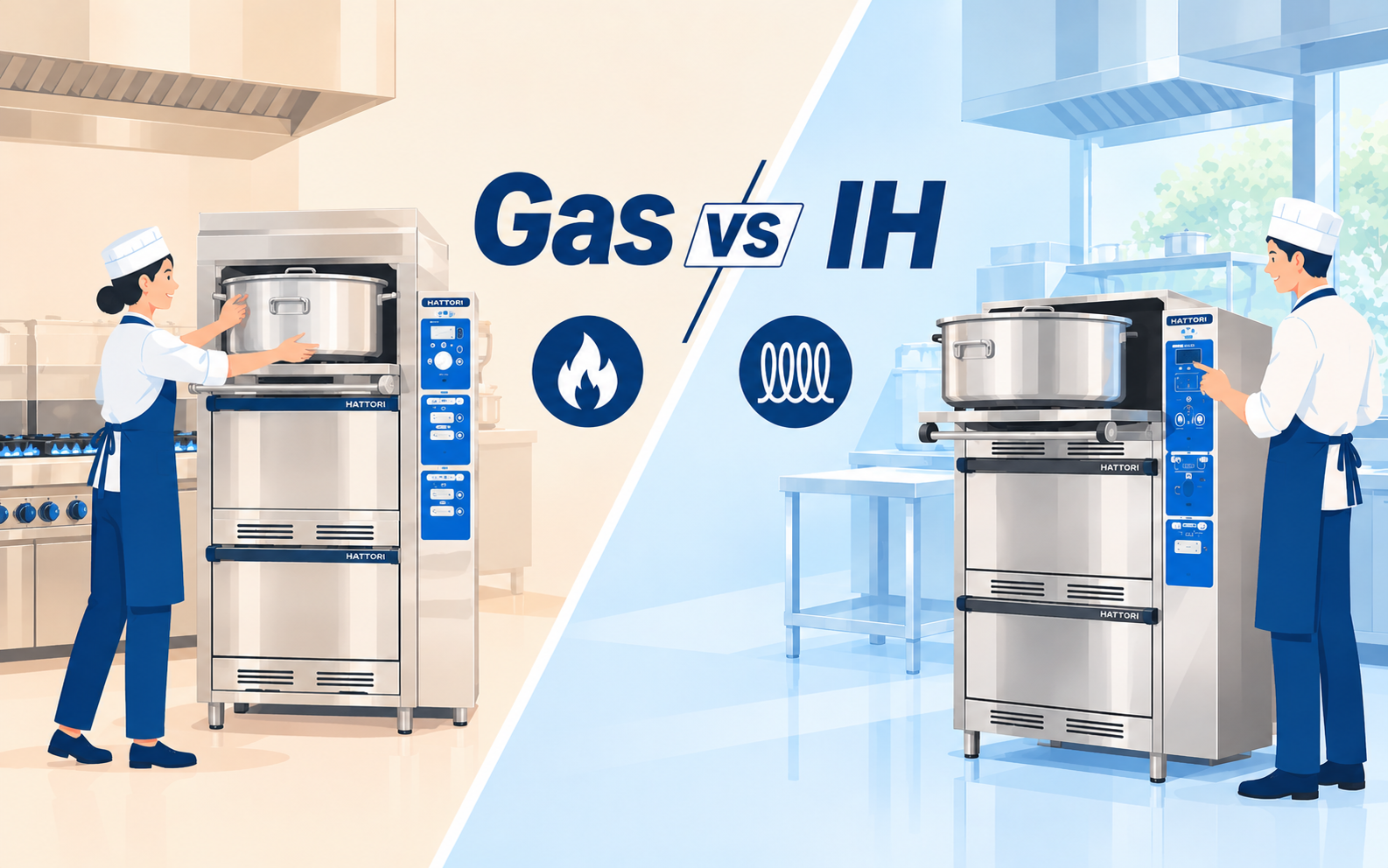
When planning or upgrading a commercial kitchen, choosing the right cooking equipment is an important decision. And of course, the heating method is undoubtedly one of the most important and fundamental factors to consider.
Gas and induction heating (IH) are both widely used in professional kitchens, but they provide heat in different ways and have different characteristics.
Before we jump into the question of which is better, let’s first look at how gas cooking and IH cooking works.
How Does Gas Cooking Work?
Gas cooking uses a burner to produce a flame, which transfers heat to the cooking vessel.
The direct use of a flame makes it a familiar choice for many professional kitchens and suitable for cooking methods that require strong, direct heat.
Gas equipment can also accommodate a wide range of cookware, making it a flexible option for kitchens with different cooking processes.
However, gas cooking also produces heat around the cooking area. Depending on the kitchen layout and operating environment, ventilation and temperature management may therefore need to be considered.
How Does IH Cooking Work?
IH, or induction heating, generates heat through electromagnetic induction. The induction system generates heat directly in compatible cookware, which allows good heat control.
Because there is no open flame, it can also help reduce the amount of heat released directly into the surrounding kitchen compared with conventional gas cooking.
Additionally, the flat surface of many IH cooking systems can also make cleaning and maintenance of the cooking area more convenient.
Gas vs. IH: What Are the Main Differences?
|
Factor |
Gas |
IH |
|
Heating method |
Direct flame |
Electromagnetic induction |
|
Open flame |
Yes |
No |
|
Cookware compatibility |
Generally broad |
Compatible cookware required |
|
Heat control |
Adjustable flame |
Precise electronic control |
|
Heat around cooking area |
Generally higher |
Generally lower |
|
Cleaning |
Requires cleaning around burners and cooking areas |
Flat surfaces can be easier to clean |
|
Infrastructure |
Gas supply required |
Sufficient electrical capacity required |
So, which is better? Gas or IH?
The answer is: it depends.
Instead, the more important question is: Which method is better suited to your kitchen?
Aside from the factors listed above, other factors should also be taken into account, including:
- The type of food being prepared
- Daily production volume
- Available kitchen space
- Existing gas or electrical infrastructure
- Ventilation requirements
- Cleaning and maintenance procedures
- The experience and preferences of kitchen staff
For larger-scale food production, the choice of heating method can also affect the overall workflow and efficiency of the kitchen. This makes it important to consider not only the equipment itself, but how it will fit into the entire cooking process.
Furthermore, the choice between gas and IH is not limited to stovetops. It is also an important consideration when selecting commercial kitchen equipment, such as tilting kettles and rice cookers.
For instance, for facilities where open-flame cooking is restricted or minimizing heat and combustion is a priority, an IH deck rice cooker can be a suitable option for preparing rice in a cafeteria.
At Hattori Kogyo, we offer both gas and IH deck rice cookers, providing options for different commercial kitchen environments and cooking requirements.
Gas Deck Rice Cookers
Hattori's gas deck rice cookers use a gas burner to heat the cooking chamber which can be a practical option for kitchens that already have gas infrastructure or prefer conventional gas-powered cooking equipment. All of our commercial deck rice cookers can be used to prepare large quantities of rice efficiently and consistently.
Deck IH Rice Multicooker
Hattori's deck IH rice multicooker uses induction heating to cook rice without an open flame. It provides electronic control of the cooking process and can be suitable for kitchens where temperature control and a reduced open-flame environment are important considerations. In addition, the cooler exterior surface helps reduce the risk of accidental contact burns during operation, contributing to a safer working environment in the kitchen.
When choosing between a gas and IH deck rice cooker, there is no single answer that applies to every kitchen. By considering these factors alongside the characteristics of each heating method, food-service operators can select the deck rice cooker that best fits their individual operation.
Whether gas or IH, Hattori Kogyo's deck rice cookers are designed to support professional kitchens where consistent, reliable rice preparation is an essential part of daily food production.